My Favorite Reads of 2025

“Read the best books first, or you may not have a chance to read them at all.” -Henry David Thoreau

2025 was another year where my life was enriched substantially by the books I spent time with. Some of these prose companions were merely diverting company, with which I flouted Thoreau’s advice! But several left a lasting mark on my head and heart. Here’s the list of those, with a few reflections on why I found each such a pleasure.

  • How To Know a Person: It’s a common observation in the US that we’re currently experiencing an epidemic of loneliness, as civic group and church attendance is down and adults report having fewer friends than at earlier points in history. David Brooks offers a prescription for that diagnosis: cultivating the skills and practices that help one get to know others. These range from asking better, open-ended questions to listening with full attention, to creating comfortable places for people to speak honestly and openly of their thoughts and feelings. Notably, this book helped me understand the importance of small talk, which I’d previously held to be valueless filler for people who weren’t ready to have real conversations. A surprisingly rich read, and well worth the time if you value the people around you and want to enrich those relationships. Thanks to my brother for the recommendation.
  • A Gentleman in Moscow: recommended by my friend Alice and my brother again, this novel chronicles Count Alexander Rostov’s confinement by the Bolsheviks over the span of decades to the Grand Hotel Metropol. It’s a measure of Amor Towles’ skills that what sounds like an awfully dull premise becomes wholly charming, largely due to the delightful character of the count, who navigates his loss of freedom with kindness, cleverness, and warmth. Seeing him gently subvert those who have punitive power over him is a constant pleasure. This was the first of Towles’ work that I’ve read; I look forward to drinking deeper from that well. 
  • Die With Zero: while I didn’t buy into all of Bill Perkins’ thinking in this book, he did manage to make me rethink my relationship with money in some pretty substantial ways. His foundational premise: since you “can’t take it with you,” use what money you have to maximize the experiences you have, remembering that various seasons of life better support various sorts of activities and experiences. Do adventure travel when your body is still in good enough shape to do so! Give an inheritance to your kids while you’re still around to see them enjoy it! And ideally, plan in such a way that you don’t end your life with a retirement account full of money from which you haven’t seen any benefit. A worthwhile provocation that came at a good time for me.
  • Ship of Theseus: This was one of two books that I took a great deal of pleasure in showing to people in person over the course of the year. At first glance, it appears to be a well-worn library book, written by VM Stratka, an author I’d never heard of. But when you crack it open, you quickly begin to find marginalia — mostly handwritten notes from one Stratka scholar to another who evidently passed the book back and forth over the span of a few years. And then other artifacts begin to fall out from the pages of the book: postcards exchanged by the two, articles from newspapers, and even secret decoder rings that can help you decipher hidden messages in the novel’s text. As it turns out, this whole thing is actually an experimental collaboration between JJ Abrams (creator of the TV series Lost and many films) and novelist Doug Dorst. I’d checked a copy out from the library when it was released, but wasn’t able to manage to plumb its depths in any meaningful way during the too-brief two-week loan. So this year I finally dug into it in earnest and thoroughly enjoyed the experience. Wholly unlike anything I’ve read before, if you appreciate stories told in unusual ways, mulling over puzzles, or just like showing off curiosities to your friends, grab a copy! (Note: the Hardcover edition can still be had new for less than $30; I’m flummoxed as to how the publisher puts such a complicated artifact on the shelves for that price.)
  • The Anxious Generation: Jonathan Haidt’s previous book The Righteous Mind was one of the best things I’ve read for helping me understand how my friends across the political aisle could possibly think the things they do. This book was hugely helpful in understanding the impact that social media has on young people. Haidt takes a premise that I initially found a bit overblown — that use of social media at a young age directly causes lasting and substantial rises in anxiety, self-esteem issues, and other mental health issues — and makes a thorough and well-researched case to support that idea. (I say this with a bit of regret, as I was an early enthusiastic adopter of social media, and encouraged my own kiddos at a young age to try it out. Knowing what I do now, I would navigate that much differently.) Notably, this book was one of the primary drivers for Australia’s recently implemented social media ban for those under the age of 16. I’m very interested to see how that legislation plays out over the next few years and which other countries follow suit.
  • Unreasonable Hospitality: to my surprise, there was a lot of overlap between Will Guidara’s memoir about creating fine dining experiences and How to Know a Person (mentioned above). Guidara focuses on creating delightful, surprising, often individually tailored experiences for visitors to his restaurants. Both in relationships with his customers and to his staff, he goes to extraordinary lengths to listen to and understand their individual needs and do what he can to meet them. He’s also an engaging writer, and shares his varied and fascinating experiences with warmth and enthusiasm. I have absolutely no desire to ever start or run a restaurant, but still found this account wholly engaging (and came away with ideas for how to make guests in my home feel even more seen and cared for).
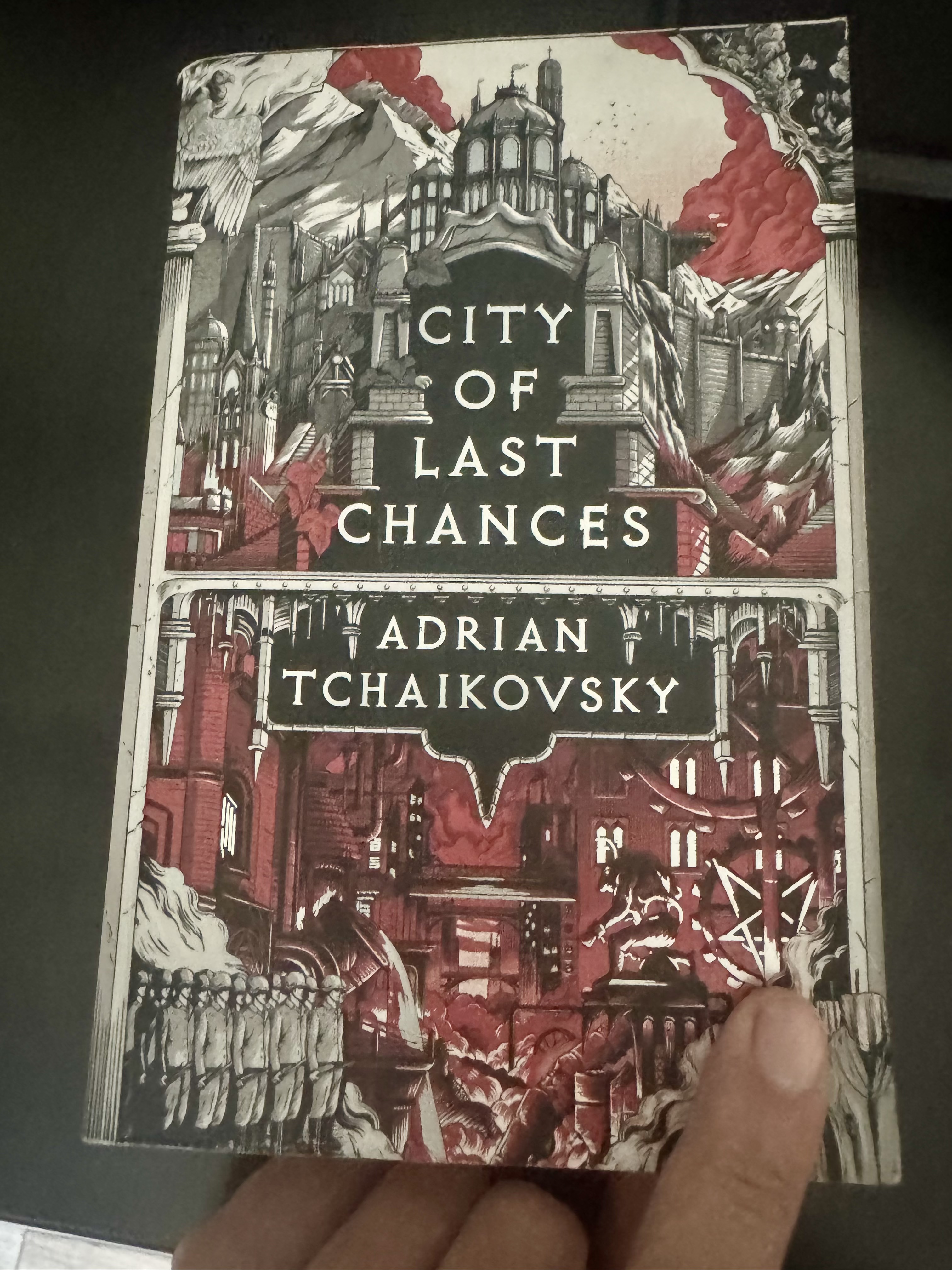
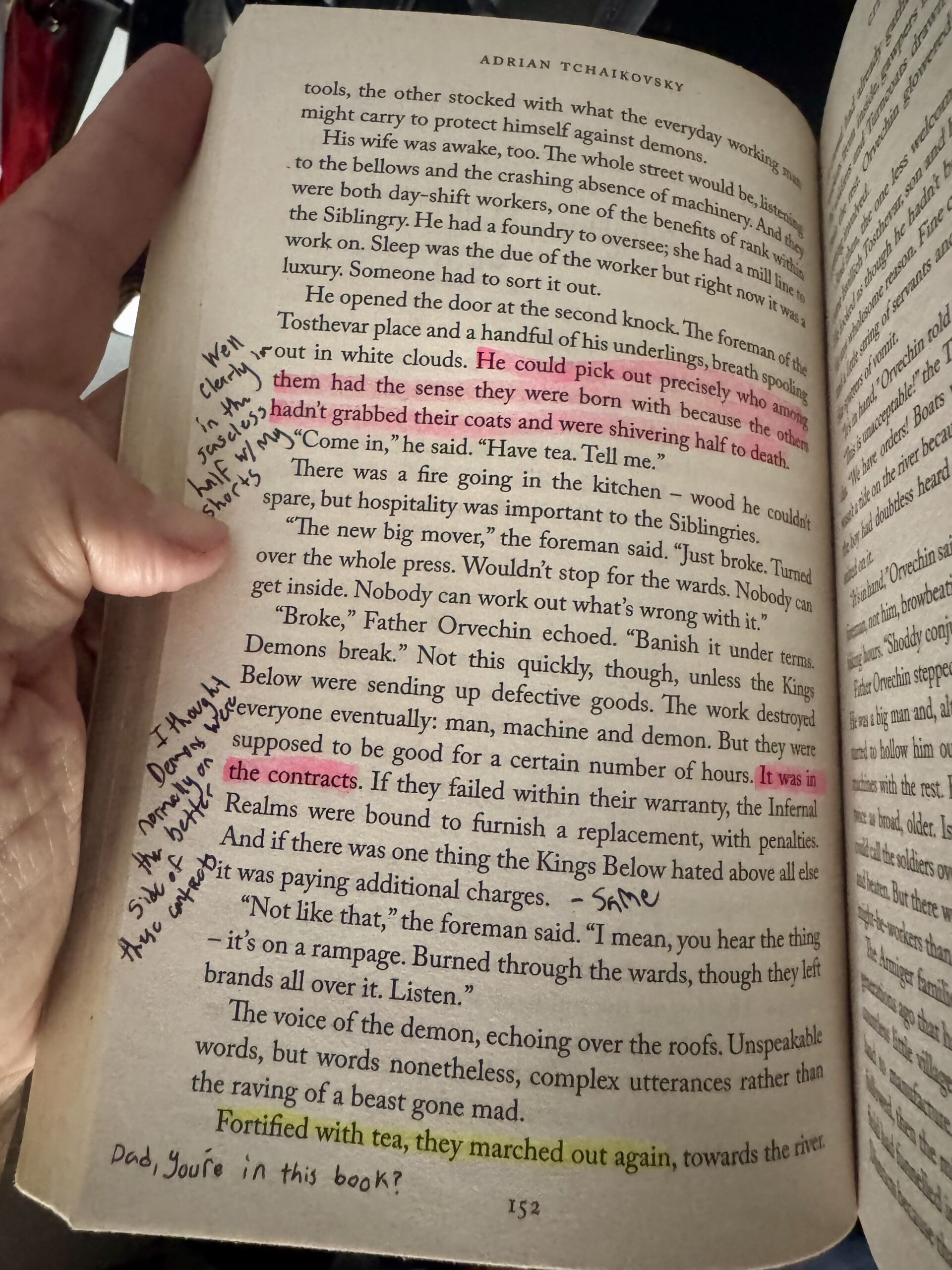
  • City of Last Chances: This is the other book that I loved showing off to others this year. Not because of anything Adrian Tchaikovsky writes in the book — though it was a thoroughly enjoyable yarn — or because it’s a notable edition. The reason I loved this slightly worn paperback is because Maggie and Liam, my youngest kiddos, had read the tale before giving it to me, and had written copious notes in the margins with their own thoughts and reactions to the story, creating a delightful sense as I worked my way through it that I was reading it with them. As reading to the kids at bedtime was one of my great pleasures when they were young, and we’re all now a bit scattered to the wind, this was an absolutely delightful experience, and one that meant a ton to me. (And if you ever want to see me tear up a bit, ask me about the time I left the book at a hostel in San Francisco.)
  • Cloud Cuckoo Land: Anthony Doerr accomplishes a number of impressive feats here: he weaves together five different storylines that don’t seem as though they could possibly intersect, he hangs these stories on an ancient Greek text that doesn’t actually exist, and he manages to evoke sympathy for a young man even as he places a bomb in a library full of children. It’s a remarkable novel that is also remarkably hard to summarize in any meaningful way. Suffice it to say that it has stuck with me, and is one of my favorites of the last several years. A wholeheartedly recommended meditation on the particular value of story.
  • The Dictionary of Lost Words: I bought a copy of Pip Williams’ freshman book for my daughter Maggie immediately after finishing reading it, largely because the heroine reminded me a great deal of her. They share a love of interesting words, a curious nature, a head of extravagantly curly hair, and the particular affection of their fathers. My enjoyment was also augmented by the fact that much of the tale revolves around the creation of the first edition of the Oxford English Dictionary, which I’d read a good deal about in Simon Winchester’s The Professor and the Madman last year. An enjoyable tale that touches on the importance of language, who gets to dictate it, and the roles of women at various times in life and places in society. Quite a debut!
  • I Who Have Never Known Men: I’ll say up front that this novel feels like a narrative cheat to me. It sets up a wonderful central mystery — what happened in Jacqueline Harpman’s post-apocalyptic world? The promise of getting answers pulled me through 80% of the read, at which point I realized (to my considerable annoyance) that answers were not forthcoming. This is a sore point for me with some of JJ Abrams’ and Arthur C. Clarke’s work, so I was particularly disappointed to again not have my questions answered. However, the fact that this was still one of my favorite reads of the year should tell you much about how solid a book it is. And my friend Johanna (who trades in stories herself) suggests that the unanswered questions might actually be constructed to help one empathize with the central character, who is similarly baffled by the state of the world and wants answers as much as we do. This one also had me thinking about it for weeks after I turned the last page.
  • The Ruthless Elimination of Hurry: Going in, I did not know that this was a faith-centered book, nor that John Mark Comer is a pastor; I merely had my brother’s recommendation to go on. While the fact that it is rooted in a Christian understanding of the world will mean it won’t be to everyone’s taste, I found his message identifying the tendency towards overscheduled busyness as an enemy to calm, spiritual depth, and good relationships a compelling one. He makes a good case that silence and solitude, carving out space for rest, and committing to fewer activities would do all of us good. I ended up giving my wife a copy for Christmas, as did my brother. I’m looking forward to us all discussing it together — as soon as we can find time on our calendars!
  • Babel: I will be the first to assert that academic dark fantasy is overrepresented in bookstores these days. Harry Potter launched a thousand literary ships. And I picked this up only because Abigail, daughter , said it was one of her recent favorites. (I didn’t realize at the time that R.F. Kuang, who was responsible for the excellent novel The Poppy War, penned this one as well.) I was quickly and thoroughly won over by the sympathetic and fascinating characters, the nuanced portrayal of both the individuals and the alternate-history Oxford in which it is set, the unique magic system which is of special interest for language enthusiasts, and the author’s readiness to explore all of the fascinating questions of race, empire and its power, slavery, and conflicting loyalties. If you can read this in the context of a book club, where you have a chance to discuss all of the themes with others, by all means do so!

In addition to the books I read in 2025, I have several I’m excited to dig into in 2026: I’ve started Leo Tolstoy’s Calendar of Wisdom, which has short selections centered around a theme to read each day. I’ve had several friends recommend The Will of the Many, and my son’s girlfriend very kindly gave me a copy for Christmas. And, speaking of Tolstoy, my brother and I have been talking about tackling Anna Karenina this year. Finally, after reading C. Thi Nguyen’s Games: Agency as Art in 2024, I’ve preordered The Score, his next work around games and their place in our lives. It’s going to be a fun year!
A Delightful Birthday Gift

A delightful birthday gift I received this year: a copy of a book from my “to read” list that my zookeeper daughter and programmer son read before me, leaving highlights and annotations for me to enjoy along with the main tale. (I had recently enthused with them about how much fun I was having with J.J. Abrams & Doug Dorst’s “S”, which tells its story in a similar way.)

I just love this.

My Favorite Reads of 2024

As is my wont, I read a fair bit in 2024. Here are the books I tackled this year that I found most interesting, challenging, engaging, and/or compelling:

(Note: I get a bit of a commission if you buy any of these books through my links.)

  • Designing Games: I was keen to read this based on the topic alone, and even more when I realized it was penned by Tynan Sylvester, the designer behind Rimworld (the computer game which has consumed more hours of my adult life than any other). It did not disappoint. It engagingly and systematically walks through all of the considerations and pitfalls involved in creating a video game. To my surprise, however, this was also the best book on management I read this year, with a trove of insights on shepherding and motivating people. I’ll definitely be applying lessons from this book to my own management practice.
  • In Cold Blood: My son read this in high school and recommended it to me then. It took me 10 years to get to it (sorry, boyo!) but I’m glad I finally did. In addition to simply being a gripping tale, it also presaged a couple of literary movements: the rise of true crime stories — perhaps most common in podcasts and documentaries currently — and historical accounts told narratively, with a combination of the writer’s extensive research and informed imagination creating a vivid account of events. (Erik Larson is one of my favorite contemporary authors doing this sort of writing.)
  • The Dark Forest & Death’s End: books 2 and 3 in Cixin Liu’s celebrated Remembrance of Earth’s Past series. Caveats: I found the reading itself less enjoyable than with many of my favorite books. The characters feel somewhat wooden, the translation from Chinese reads a bit stilted, and the foreshadowing is at times so heavy I was left wishing my audiobook app had a “skip to where the other shoe drops” button. But oh boy, for sheer number of interesting ideas woven into a compelling narrative and for epic scope, I can’t think of anything to beat it. 
  • Educated: my son’s girlfriend recommended this autobiographical account of a young woman’s emergence from a very sheltered religious upbringing into the wider world of people and ideas. Westover’s luminous prose, the harrowing accounts of the abuse and neglect she navigated, and her compulsion to understand herself and the compelling beauty she finds in the arts make this a riveting read, front to back.
  • Piranisi: I discovered Susanna Clarke’s first book, Jonathan Strange and Mr. Norrell, entirely by accident in a bargain bin some years back. It was rich and wonderful, and I was eager for more from the freshman author. Unfortunately, health challenges have kept her from publishing very often, but Piranisi was a delight that turns, by book’s end, into an entirely different delight. Recommended for fans of mystery or the fantastic. (Note: I just now learned the origin of the protagonist’s name. Further wonders!)
  • White Too Long: the first church I attended willingly, rather than under duress from my parents, was Trinity, a Southern Baptist Church in San Antonio. I was shocked and dismayed to learn early in this book that the Southern Baptist denomination had its 19th century roots in the pro-slavery movement. From there, the book traces the history of white nationalism in the US. It was a good history lesson for me as well as providing some excellent insight into the current state of the nation. (This book was also notable to me because I picked it up at Ebenezer Baptist Church, where Dr. Martin Luther King used to preach.)
  • The Everything War: a history of Amazon, from its scrappy founding, to the wake of would-be partners that have had their ideas and products appropriated, to the difficult conditions under which company employees labor. This was a revelatory read, and has given me plenty of motivation to buy things from other vendors whenever possible. (Balance this, however, with the fact that I loved touring one of their distribution centers a few years back and seeing human and machine working together in an intricate dance of logistics.)
  • Surrender: As a long-time fan of U2, I was keen to grab a copy of Bono’s book as soon as it came out. It took me a good spell to read through it all because of its rich, poetic, episodic nature — reading a single story was delightful and left me satisfied for a week or two before I’d want to go back for another. The Irish love of storytelling comes through strongly, and it’s fascinating to get to better know Paul Hewson, his loves, his family, his thoughts on art, and his reflections on getting into an on-stage fistfight in the early days of the band.
  • Let Your Life Speak: My brother recommended this short book to me a few years back, and when I finally got to reading it, I was annoyed that I hadn’t gotten around to it sooner. It’s a stirring and honest exploration of one’s calling in life, and affirms the idea that we’ll be most fulfilled when we’re working with the fabric of our innate natures rather than fighting against it. I also very much appreciated, enjoyed, and occasionally burst into laughter at Palmer’s account of his experiences with Quaker spiritual practices.
  • Games: Agency as Art: As an enthusiastic player (and occasional designer) of both computer and board games, I sometimes feel a little bit defensive of the hobby. This book provides an excellent exploration of the unique value of the medium as a conveyor and creator of experiences, and puts into clear words many ideas I’d had lurking in the recesses of my mind (as well as providing a wealth of new ones). If you feel that games have value and want to be able to articulate what that value is, find a copy of the English translation and dig in!
  • After On: AI has been much on my mind the last couple of years. I’ve been using LLMs in both my programming practice and personal life, as well as building AI-based products at work. Last year’s reading of Human Compatible gave me some good grist for the brainmill on how to keep runaway AI from turning us all into paperclips. This novel provides a very entertaining alternative vision for how a human-aligned AGI might come about (and nearly doesn’t). The plot threads do eventually all come together, I promise!
  • Stories of Your Life and Others: For sheer pleasure per word, Ted Chiang’s short story collection topped my reading list this year. From his reimagining of the Tower of Babel tale, to Story of Your Life, the linguist’s reminisce that was the inspiration for Denis Villeneuve’s movie Arrival, to Liking What You See, a fascinating gendankenexperiment on how society would change if we didn’t see human beauty, there was so much to savor in this collection that I’ve spent the rest of the year recommending it to anyone who would listen.
  • A City on Mars: I have quite complicated feelings about Elon Musk. But I don’t know of anyone better at starting from first principles and taking the necessary steps to move toward a goal. His compelling vision that humanity should be a multiplanetary species has driven his successes at SpaceX, Tesla, and Starlink, and has been amazing to see put into action. When the Wienersmiths announced their exhaustively researched (and liberally cartooned) examination of the challenges of humanity setting up shop on the nearest likely planetary neighbor, I preordered immediately. Simultaneously scholarly and full of delightful off-color jokes, it’s a must-read for anyone with an interest in the subject matter.
  • The Perfectionists: This was the first book by Simon Winchester that I’d read, and I was so taken with it that I followed up with Krakatoa and The Professor and the Madman later in the year. This far-ranging history of precision engineering, from the challenges of building cannons and steam engines precisely enough to not leak or blow up, to the staggeringly sensitive gravity observatories that detect subtle distortions in spacetime and are arguably the most precision-engineered artifacts ever created, is engaging throughout. Hearing it in Winchester’s delightful English accent is a bonus of the audiobook version.

What a rewarding year in the stacks! I’d love to know what your favorites have been, as I’m always eager to hear what ideas, tales, and provocations have engaged my friends, and constantly looking for good recommendations. Please drop me a note!

Five Stories, Four Walls, One of them Broken

I love a good story. I especially love a good story when it’s really well told. But I get the most excited when I encounter a good story that’s told well in a way that’s new to me.

On a recent family trip, we stopped to visit Meow Wolf in Santa Fe. I had lobbied to make it a point of call for us on the strength of a scant few facts: it had enlisted dozens of artists to create a fun house for adults, and it had $3.5 million of George RR Martin’s “Game of Thrones” fortune behind it. The nutritious vegetables of art combined with the delicious cheese sauce of lasers, arduinos, and black lights? Yes, please.

What I didn’t realize until we arrived and began exploring was that there’s a coherent narrative that underlies all of the mad, divergent installations that fill the House of Eternal Return’s 20,000 square feet. The story of an Orwellian totalitarian society, a family of experimenters, and an immortal hamster is told by means of pictures, a clothes dryer you crawl through, interactive exhibits, diaries and notebooks, and newspaper articles. Exploring the vast, dizzying space while stumbling across clues as to what happened to this family and where it lead them was one of the most engaging narrative experiences I’ve had in a long time. (Caveat: when at peak capacity, it becomes tough to fend off the jostling crowds enough to dig into the storyline. The “Blue Man Group has a rap battle with Burning Man while Tim Burton judges” vibe is still terrific, though.)

While not everyone has a taste for this sort of creative weirdness, I love it when storytellers try new things. If you’re a fan of this sort of thing, here for you are a few of my other favorite stories told in unusual ways:

The Skin of Our Teeth

Thornton Wilder’s “The Skin of our Teeth” was the first play I remember seeing where the characters of the play address the audience directly, and the world of the story gets thoroughly mixed with the world of the play’s production. It blends the silly, serious, and sublime irresistibly. When I saw it for the first time in High School, it was one of the most emotionally affecting experiences I’d had up to then, even 40 years after it won its Pulitzer Prize. It gets produced from time to time on both amateur and professional stages; keep your eyes open for it!

Device 6

Device 6” is a narrative game that runs on iOS devices. While largely prose based and story driven, it does weird and wonderful things with the text that wouldn’t be possible in a more traditional medium: turning words of the story itself into a map of the protagonist’s travels, blending beautifully-produced audio into the game’s puzzles, and having the soundtrack’s composer make an appearance in-game. It’s well worth the purchase if only to see the fascinating narrative devices that Simogo uses to tell its tale; the fact that it’s actually a good story is lagniappe.

S (Ship of Theseus)

Doug Dorset and J.J. Abrams, the same fellow who brought us “Lost” and some of the recent “Star Trek” and “Star Wars” films, also penned “S” (also known as “Ship of Theseus”), a terrifically interesting experiment in narrative in novel form. There are several parallel stories going on as you read through S: one is the text of the book itself. Another is a dialogue in the margins, purportedly left by readers of this copy of the book who wrote back to forth to each other in marginalia. Additional depth comes through other “real world” items — postcards, newspaper articles, ticket stubs — stuck in the book. Reading through all of these things and piecing together how the disparate parts fit together provides a wonderful sense of being “in on it,” of having stumbled across a rich, private world by accident.

Majestic

Back in 2001, when I was working for Electronic Arts, that company launched Neil Young’s “Majestic,” a groundbreaking Alternate Reality Game. At its heart, Majestic was a conspiracy-theory riddled science fiction thriller. The storyline itself wasn’t particularly novel, but the way it was played was different than anything that preceded it. Rather than launching a game on the computer, players interacted with the narrative using all of the tools of real life: they received emails and faxes from characters in the game, got chat messages, scoured real websites for clues, and fielded phone calls and voice mails that advanced the plot. This blurring of the lines between real life and the game was fascinating and made for a really compelling narrative experience, and increased my disappointment when the game was cancelled around a year after its launch.

Each of these experiences tried something new and made their stories richer. They are some of my very favorite storytelling experiences as a result. What are some of your favorites that have tried new things and pushed the boundaries of the form?

Christmas Letter 2013

(This is the non-illustrated semantic HTML edition. Also available: the fancy photos-included PDF edition.)

Dear family and friends,

It has been quite a year for our family. We’ve enjoyed some great times together  with family and friends, a few promotions, a terrific (though slightly bittersweet) family vacation, a visit with alligators, an eviction from our house, a repatriation, and a new addition to the family. Read on for all of the details!

Kathy began the year working at Horizon Bay, an elder care facility around the corner from our house, as a caretaker. While she has a fantastic affection and gift for interacting with older folks, this was not a completely ideal appointment: it demanded a fair number of overnight shifts and other times that were inconvenient for her and the family, and it didn’t make much use of Kathy’s Therapeutic Recreation degree. After proving her worth and presenting her case to her boss, he appointed her Program Director for Clare Bridge, the Alzheimer’s community at Horizon Bay — a role that hadn’t existed before. She has received a number of accolades in her new position and, more importantly, loves it.

Emily continued her schooling, taking a few more art classes at ACC where she turned in some excellent work and continued to expand her artistic skills. In the middle of summer, she completed a long-planned move to Baltimore, which has the dual attractions of an art school that she’s interested in and portions of her family that she wanted to spend more time with. Her first few weeks there were a trifle rough: her car was broken into the first day she was there and the rougher sections of the city had her feeling a bit ill at ease. After selling the car and moving to a better section of town, she began to feel much more comfortable with the city, and is now enjoying it a great deal. She’s taking classes there and has been working a job at The Pratt Street Ale House for several months now, and has enjoyed the opportunities to visit with family and friends up in that part of the country.

Abigail is now in her Senior year at the high school. She’s taken up swim team this year, and has done quite well. She is turning in solid times on her events and enjoying her team and teammates a good deal. She has also been learning ukulele (it’s easier on her fingers that guitar was) and continuing to do some singing. One of her favorite classes at school has been a Special Education PE class, where she helps the kids there to stay fit and engage with others. Her plans for next year are still a bit murky, but we’re talking about and weighing the advantages and expenses of work, travel, college, etc.

Liam is halfway through his Freshman year. He has found the transition to High School easier than he expected, though the demands of marching band came as something of a surprise to him. In the month before school started, the band would arrive at 7:30, march until noon, and then practice inside until 5:00. During the first week of that, he would come home, eat a bit, sit in a chair in the living room answering questions in monosyllables, and stumble off to bed around 8:00. His playing is excellent, and he earned second chair among all the French Horn players at his school, beaten out only by one senior. He’s pulled straight A’s so far, and has also been learning some programming in his spare time, writing a few iPhone apps with a little coaching from Dad.

Maggie is now in 7th grade. She continues be a great favorite of her teachers thanks to her sweet nature, generosity, and willingness to work hard. She loves animals, and was delighted at the opportunity to have a lengthy horse riding lesson over the summer thanks to some friends of ours. (It was accompanied by a shooting lesson as well, at which she did startlingly well.) She also continues to enjoy art a great deal, and created several lovely pieces for family members at Christmas. Stories are also a favorite of hers. She’s enjoyed reading and rereading Maximum Ride and Harry Potter this year, in addition to reading through Jurassic Park, Terry Pratchett’s Dodger, and All Creatures Great and Small with her Dad.

Sean is finishing up his second year at Mutual Mobile, where he has been writing iPhone and iPad apps. He recently moved to an Associate Director role, which means less day-to-day programming and more strategic work and caring for people there. He’s also playing music with O’Malarkey, a local Irish band, whenever he can squeeze in the time, and has been enjoying cooking for family and friends more this year. The building of a 25′ tall trebuchet, some delightful long hikes, and a train trip to Chicago with Liam and Sean’s brother rounded the year out nicely.

Over the summer, knowing that Emily was planning her move to Baltimore, we pulled together a last big family trip: a week in New Orleans, where we had spent a day as a family a few years back and all really enjoyed. The vacation was terrific. We stayed on the edge of the Vieux Carré, and enjoyed rides around town on the streetcars, trips to the botanical gardens, aquarium and insectarium, and one of the most memorable meals we have ever enjoyed. (At Jacques Imo’s — “Warm Beer, Lousy Service” and highly recommended.) A particular highlight of the trip was a boat tour through Honey Island swamp, where we met a family of friendly warthogs and saw a number of alligators up close.

Alas, when we returned to San Marcos, it was to a home with a broken toilet supply line which had flooded a good portion of the house. Some of our good friends were checking on the homestead while we were gone and discovered the problem before it got even farther along, but it still ended up causing tens of thousands of dollars of damage. We moved to a three bedroom apartment for “no more than 45 days.” That ballooned to three months before we finally got home. Fortunately, USAA (our insurance company) was very helpful, one of our church friends was gracious enough to build us a beautiful new built-in bookcase, Kathy was able to replace the abhorrent pink tile that has lurked in our bathroom since we moved in, and the house now looks better than when the whole ordeal began.

During our exile, Maggie got stuck sleeping on the couch for much of time time which, understandably, became tiresome for her partway through our stay. As a thank-you for her forbearance, we (perhaps rashly) promised her a kitten upon our return home. Hewing to the family tradition of absurdly named animals (“Fluffy” the hermit crab, “Llama” the gerbil, “Hasenpfeffer” the rabbit), she christened her new black kitten “Mayonnaise”. He’s quickly made himself at home, and has even won over Liam, the most pet-skeptical among us.


As we review our year, it is apparent how blessed we are to have such terrific family, such wonderful friends — what a different year it would have been without those of us who give us regular support, and those we know are further off in the wings, ready to offer friendship when it’s needed. Thanks for being a part of our lives, and for allowing us to be part of yours.

May all the joys of this blessed season be yours in full measure. Merry Christmas!

The Clan McMains

(San Marcos Chapter)


From the Mixed Up Files of Mr. John Rogers

This earned a tea-snort from me this morning:

There are two novels that can change a bookish fourteen-year old’s life: The Lord of the Rings and Atlas Shrugged. One is a childish fantasy that often engenders a lifelong obsession with its unbelievable heroes, leading to an emotionally stunted, socially crippled adulthood, unable to deal with the real world. The other, of course, involves orcs.

Thanks, Kung Fu Monkey.

Kindle Impressions

I’ve had the opportunity to spend some time with an Amazon Kindle over the past week. The Kindle is Amazon’s attempt to bring book reading and distribution into the 21st century. It’s essentially a small, purpose-built, handheld computer that incorporates several interesting technologies to create a compelling experience for the book lover.

The first distinctive thing about it is the display. Rather than using the LCD or OLED screens that are common on laptops and cell phones, the Kindle uses electronic paper, a display made up of thousands of tiny capsules filled with black and white particles that can be dragged to the top or to the bottom electronically. It functions (and looks) a bit like a high-resolution Magna Doodle.

This screen provides a couple of advantages: first, it gives the kindle a distinctive, book-like appearance. Though the 800×600 display isn’t quite as high-resolution as print, it looks very good, and the four gray scales allow for some basic graphics and diagrams to be included (and some lovely screen savers). One might reasonably wish the background color were a purer white, rather than a light grey, but the constrast ratio is still very high, close to that of a newsprint. Second, the electronic paper display is extremely power-efficient. Because it only draws power when it is changed, the Kindle can run for up to a week on a single charge — something unheard of with emissive displays. Third, because it is reflective, it can be read in all the same conditions one could normally read a book — bright sunlight presents no problems. (The ironic flip side of this advantage is that you need a book light to read it in a dark room.)

The second distinctive thing about the Kindle is that it has a built-in wireless data connection that runs over Amazon’s Whispernet service. Amazon subsidizes the service through device and electronic book sales — it doesn’t cost anything to use. It’s built on the cellular phone network, and therefore has excellent coverage, though the bandwidth is fairly limited. However since it’s used primarily as a delivery mechanism for textual content, that’s rarely a concern. One can use the device to grab a sample of a book from the Kindle store nearly instantly, and can download an entire purchased book within about a minute.

According to the hackers, the software that runs the whole show is largely Java on top of Linux. However, as a user, you’ll never be aware of the fact. The system is controlled with an easy-to-use system of menus which are almost entirely accessed through a little scroll wheel. I gave Kathy (who will be the first to admit that she’s no big fan of technology) 20 seconds of instructions on how to use the scroll wheel while we were driving to San Antonio last week, and she, without further help, kept herself entertained for the two hour car ride downloading sample books, reading, and exploring the device — an impressive testament to its ease-of-use.

There is currently no SDK for the device, so one is limited to running the applications that Amazon ships with it. Amazon has hinted that they might consider creating an SDK in the future, but hasn’t made any official announcements yet. Even so, the Kindle is quite functional. One can, of course, buy and download books from Amazon’s library at rates substantially lower than what one would pay for a hardcover edition. Amazon also has a conversion service where you can send a variety of document types to a special email address and have them converted into a format viewable on the Kindle. It costs $0.10 to have the document sent to your Kindle over Whispernet, but is free if you use the included USB cable to put it on the Kindle yourself. Since the Kindle registers itself as a standard mass storage device, you can transfer files to it easily using a computer with Mac OS, Windows, or Linux with no additional drivers.

Amazon also includes several experimental applications, including a music player, a human-backed question answering service, and, most interesting, a basic web browser. While the browser doesn’t support a lot of advanced features, it works well for browsing well-formatted content, and is even quite usable for some web applications. I’ve been able to update my Twitter while walking home, though haven’t yet convinced it to display my RSS feeds in Google reader. Though the browser isn’t as good as Mobile Safari, its reliance on the cellular network means that I can use it in many more places than the iPod Touch, which relies on having a wireless access point nearby.

While the Kindle has a lot to recommend it, it’s not perfect. The display takes about 3/4 of a second to refresh when you move from page to page. It’s very easy to hit the Next Page and Previous Page buttons by accident. It’s rather homely. Purchased books are wrapped up in DRM. And it’s expensive.

However, by taking advantage of its unique place in the book selling market, Amazon has managed to create the most viable electronic book yet. For the traveler, the reader, or the person who needs convenient access to a reference library, it’s a very compelling product — and a lot of fun.

Some Reading For The Summer

Here are a couple of books I’ve quite enjoyed recently:

  • Irresistible Revolution: Living as an Ordinary Radical: Shane Claiborne, the author of this book, is an interesting cat. He’s passionately devoted to the idea of living according to Jesus’ teachings in the New Testament, especially with regard to the poor and disenfranchised. I particularly enjoyed his accounts of time serving alongside Mother Teresa and as a peace emissary in Iraq. He also is engaged in some of the intentional community stuff that I get worked up about from time to time, and so found a particularly receptive audience in me. Stimulating and well worth the time, even if you don’t agree with Shane’s conclusions.
  • Little Brother: Cory Doctorow’s latest, in which a teenage boy runs afoul of the Department of Homeland Security and, after being released from a secret detention facility, decides to try to take the DHS down using a variety of interesting technology and tricks and teaching the reader about them along the way. A very-near-future dystopian novel in the vein of 1984 or Brave New World, I found it very compelling reading. One of the great things about Doctorow’s work is that he makes it available under a Creative Commons license, which means you can download and read his book for free! [Exercise for the reader: compare Doctorow’s insistence here that privacy is vital to a free society with David Brin’s insistence that privacy is a lost cause and visibility should be embraced instead in The Transparent Society.]

Do you have any recent favorites? Post them in comments! I’d love some good summer reading.

My New Favorite Book

Last week, Liam brought home a small book that he had created in school. I thought it was great, so am posting its entire text verbatim here. Enjoy!

Playdate with my dad pg 1

“OOOOOOH” this is going to be fun I said gleefuly on an early summer morning.  I am going on a very long play date with my dad. “It is going to be so fun” I said. First we went to a place called Peter Pan’s Mini Golf. I got a black putter with shiny new ornge ball. My dad got an ornge putter with a Shiny yellow ball. I got almost every hole a hole in one but two of them got hole in twos and one hole in three. one of the holes had a hill and I got a hole it two on that one. It was so fun at the mini golf place. Next we went to a very fun place called kid town. they have more mini golf, basketball, three playgrounds and a singing area (which you know I did not go on). First I played basket-ball. It made me so tird that I had to drink almost a gallon of water. Then I went back and played some more. Next I went and played on the playground for a very long time. my dad look lots of pictures of me.

Playdate with my dad pg 2

Next we went to a resaruant called the Alamo Steak house. I found a gum-ball machine and if you got a black gum ball you got a free meal and guess what!? I got one of the black ball’s so we got a free meal and I chose the all you can eat buffett. I nearly barfed because I ate so many fries! Next we went to go swim in the San marcos river. I was collecting rocks for my collection. I found a heart Shaped one and gave it to my dad. Next we played with water guns and water balloons up in the grass. I acidentaly knocked my dads glasses of his head but luckily he found them in the tall green grass. next we went to mr. gatties and ate pizzia. It tasted very good. Next we went to the game Room. I had one hundred tokens and i bet you can’t guest how many tickets I got!? four thousand eight hundred thirty seven. i got a pool table, lava lamp, glow in the dark things, a pretend samiri sord and too-tsie Rolls. Next we went home wathch pirates of the caribean and went to bed.

Thoughts on Kindle

Amazon has just introduced a new electronic book reader called the Kindle, which looks pretty interesting. My thoughts while reading the details:

  • First mass-market use of electronic paper for a display. I wonder what the resolution is like? Ah, 800×600 with 4 levels of gray. (By comparison, the iPhone is 480×320, though it’s smaller and full color.) The screen refreshes in the video are kinda wacky. Pros: high contrast, shatter-resistant, low power draw. Cons: you need a booklight to read your electronic book! (Thanks to Mark for pointing that out.)
  • I really like the idea of being able to buy and have a book available in a minute or two, especially given that they appear to be selling for much less than their hardcover equivalents. Yay, cheap!
  • They tout the ability to read blogs, but apparently only those that Amazon chooses. I hope they update it to support any RSS feeds, though given that they have to make enough money on it to pay for the wireless service they supply, that may be challenging.
  • I wonder what the headphone port is good for? Are there audiobooks in its future? Text-to-speech? Nobody seemed to use it in the videos.
  • There’s a USB port and another port or two I wasn’t able to immediately identify on the bottom of the thing. It should be interesting to see what the Internet hackers are able to do with the gadget.
  • The decision to use a cellular network is an interesting one. Pros: coverage everywhere, low power. Cons: because piggybacking on someone else’s data network costs them money, they’ll have to pay for that somehow. Thus, free content (such as individual’s weblogs) will be hard to come by.
  • You know what else this ought to connect to? Allrecipes.com. I’d love to have a giant virtual cookbook on my kitchen counter.
  • The “Email a Word file and have it sent wirelessly to your Kindle” feature is pretty cool. Nice to have easy access to reference copies of your personal documents. Seems like Doctors and Lawyers would really dig this aspect of it.
  • 256MB of internal storage seems a little paltry, but I guess if you’re storing compressed text, it would go a long way.
  • Maximum operating temperature is 95°? So much for using it outside in Texas summers.
  • I expect the Amazon content will have DRM slathered over it. It would be very nice if one could also put one’s own content (like Project Gutenberg texts) on via the USB port without wrapping it up in some wacky rights management scheme.
  • It sure is homely.