
Cuckoo Clock

Our department has an annual white elephant gift exchange. If you’ve never participated in one, they go something like this:

  • Player A chooses a wrapped gift from a pile and unwraps it.
  • Player B then can select another wrapped gift, or steal Player A’s. Player A then selects a new wrapped gift.
  • Player C selects a wrapped gift or steals one of the other player’s. They then have the option to steal from someone else, eventually forming long looping chains of theft, or to choose a new wrapped gift.
  • And so on until everyone has had a turn.

This year, there were two gifts that came up that I was interested in: a couple of bottles of beer and a beanie. I managed to have both pass through my hands about a half dozen times before I decided to end the madness: I took a horrible silver plastic battery powered cuckoo clock from another player and finished the rest of the game unmolested.

 

cuckooclock1.jpg

After the exchange concluded, I left the clock in its packaging for a couple of weeks on my desk, while I pondered what I could possibly do with this travesty of a timepiece. After much thought and consideration, I decided that the appropriate answer was this: cause some mischief.

So, on the night of December 27, when my compatriot Jeff Snider and I were already in the office late at night for a system update, we decided to strip all the faux-bavarian plastic off of the clock, remove the hands, and hide it in our boss’ suspended ceiling, where it would peal forth hourly with its sickly electronic mewling. We taped up the speaker to make it a bit quieter (and therefore more difficult to find), lifted a ceiling tile, tossed it on top of one of the light fixtures, and beat a hasty retreat.

When everyone came back from the holiday, we were surprised to hear nothing about it for a couple of weeks. It occurred to us that we hadn’t actually stuck around long enough after putting the batteries in for the first time to verify that it was working correctly, and wondered if our prank had been stillborn. Word came to us through the grapevine a few days later, however, that it was indeed causing some havoc. Reports escalated for a few days after that until the situation finally came to a head in a fairly entertaining fashion. The story, as I’ve reconstructed it from various people’s accounts, is this:

After a couple weeks, Mike had had enough of the dreadful electronic caterwauling, and came storming out of the office, asking “what is that horrible noise? Has one of you got that as your wretched cell phone ringer?” Kay, the administrative assistant, explained that she (rightly) thought it was coming from his office, and assumed it was some kind of gadget or alarm that he had set up.

They then noticed that it was going off regularly at 13 minutes after the hour, and knowing now to expect it, grew increasingly agitated with the situation over the next few days. Finally, one afternoon, Ron (of Ron-A-Thon 2007 fame) had enough of their frustration, and pulled a ladder into the work area and started rooting through the ceiling at the appropriate time. He quickly located the loose bundle of batteries, a timepiece, and wires, and reached the conclusion that any right-thinking person would:
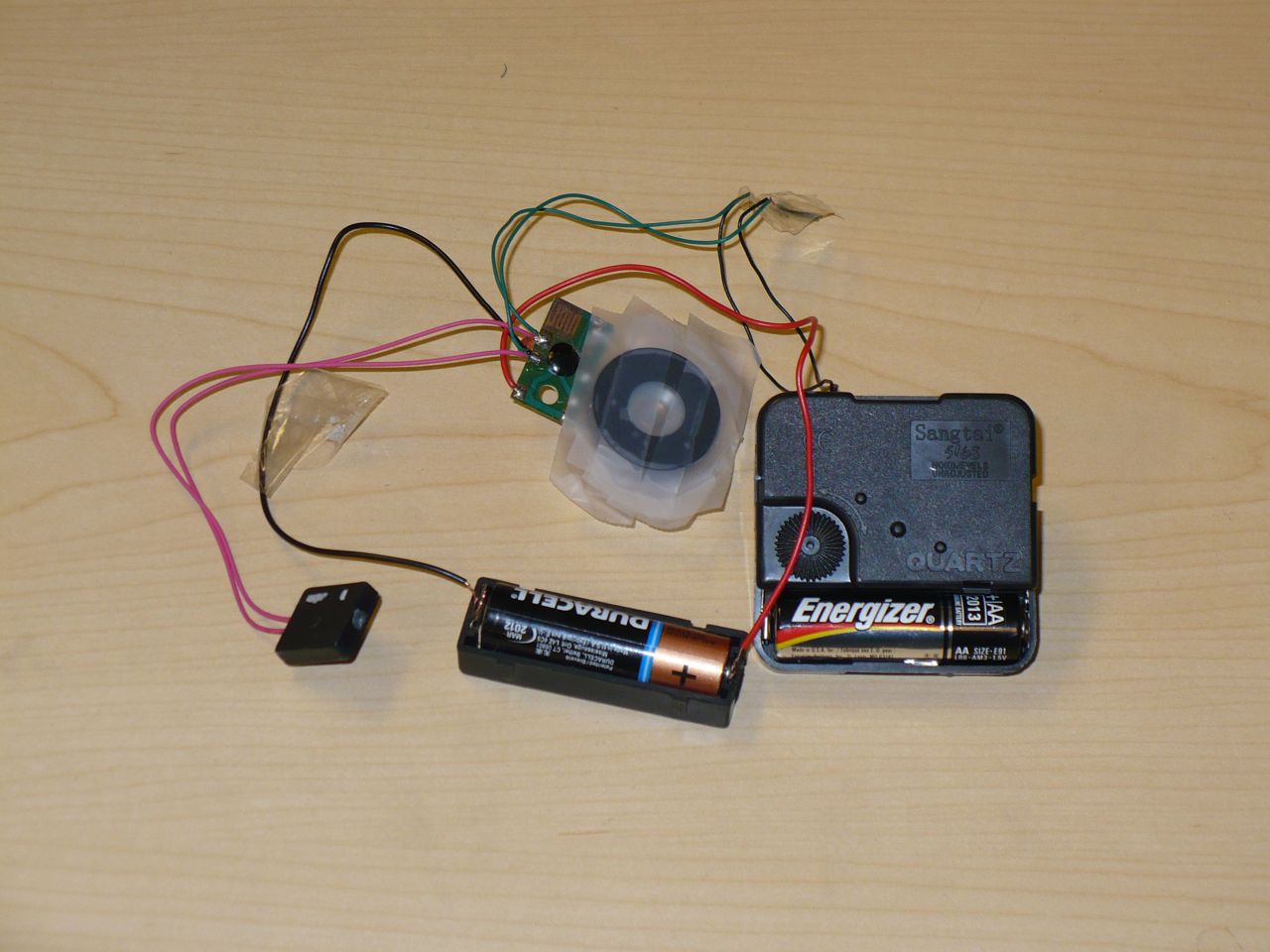
 

Gutted Cluck

He thought it was a bomb.

They called Joan, the head of the library in which we all work, and Todd, one of her staff, to have a look at it. Todd fortunately quickly reassured everyone that it looked harmless, and was most likely just a prank, thereby narrowly averting an evacuation of the building and a visit from the local constabulary. (And, incidentally, allowing this story to actually be told.)

Kay kept the gadget on her desk for a few days while Mike began asking pointed questions in staff meetings: “Do any of you know anything about a little electronic chime that was in my ceiling? We think it may have been pulled out of one of those musical greeting cards as a prank.” We all had a good laugh about it in the meeting, feigning ignorance until Mike had the perspicacity to start asking people individually “Did you have anything to do with this?” Jeff, unable to tell a lie, hedged until Mike was sure he was involved. From there the whole sordid tale came out.

Fortunately, all the involved parties had a good sense of humor about it, though Mike has promised revenge most foul will come our way when we least expect it. I say: Let the games begin!


XO Laptop: First Impressions

We got in our XO Laptop, the little unit that the One Laptop Per Child organization has begun producing and making available to poorer countries for less than $200 per laptop. (Read David Pogue’s article for a quick introduction to the concept.) Here are my first impressions after fiddling about with it for an hour or two:

  • Holy moley, it’s tiny! Somehow, like celebrities, it seems even smaller in person than in pictures.
  • It feels very much like it’s engineered with kids in mind. The interface is straightforward, rewards exploration, and doesn’t rely much on the habits that adults might have developed in computer use.
  • The keyboard is much more responsive than I’d expected, though it’s definitely awkward for touch typing with adult hands. High speed hunt-and-peckers will do better here.
  • The selection of built-in applications is wild and wonderful, with a strong leaning toward things that let kids create music, software, reports, etc.
  • I haven’t yet been able to figure out how to have multiple browser sessions open (like tabbed browsing or multiple windows) without launching several instances of the Browse app.
  • I love that the mic jack can also be used for other analog inputs, making it easy to connect up things like thermometers, PH gauges, accelerometers, etc.
  • This is clearly a machine purpose-built for curious young minds. Having some time with it has convinced me that Intel was shortsighted to pull out of this initiative, as no laptop running Windows XP is going to be as rewarding for kids to explore. On the other hand, American consumers who are used to being able to get things done with a minimum of fuss won’t be as happy with it.
  • Applications do launch a bit slowly, though they’re pretty snappy once they’re up and running. No crashes or unexpected application exits yet, though admittedly we haven’t pushed it too hard.
  • The idea of the Journal is a really interesting one that may reach mainstream computing eventually. Instead of saving documents in a file system, the computer just tracks what you’ve been up to lately, letting you mark the most important stuff to be saved. You can then search through that record chronologically or by search term and pull up old sessions, right where you left off.
  • Collaboration is built in at a very low level. Nearly all the built-in applications allow you to share what you’re working on with others who have XO Laptops and to work on those things collaboratively. In addition to the obvious cooperative uses, this will be useful in classrooms without projectors where the teacher wants to demonstrate techniques or sites to students.
  • The Browse application uses the Gecko engine, the same one as Firefox, so all those fancy web applications like GMail and Facebook work just fine on it.
  • The screen switches into a high-resolution (200 dpi) black & white mode when you turn down the backlighting all the way. Combined with a button that lets you rotate the information display in 90° increments and the ability to fold the screen back down over the keyboard, this makes a dandy device for reading texts. (When in black & white mode and using a reading application, battery life should approach 24 hours, thanks to a passel of nifty technical tricks designed to keep power draw at a minimum.)

For its intended purpose, it’s a brilliant piece of work. With a connection to the Internet available, it has the potential to be a magnificent educational tool for students who otherwise might not have access to much of what the modern world has to offer.

So, congratulations, OLPC folks. You’ve done a great job, and I wish you the best of success getting your vision out to the rest of the world.

A Photo A Day Project

I’ve been feeling a bit frustrated lately that my creative output has been so meager. As a counter to that, I have decided to embark upon a project for February: A Photo A Day. Inspired in part by amboo_who‘s faithful and excellent photographic chronicling of her daughter’s growth, I thought this would be a fun way to get the juices going again.

Why February? Because February’s the shortest month and I am lazy.

While I think this would be fun as a solitary exercise, I think it’ll be more fun with friends. So if any of you photographers out there want to play along, here are the guidelines:

  • Let me know you want to participate.
  • Post one photo each day of February to your Flickr account. (Don’t have one? Get one! They’re free.)
  • Ideally, the photo should be one that you’ve taken that day. Barring that, recent is good. Failing that, you can dig into your archives for something you haven’t posted before.
  • Include a paragraph or two with any information about the photo you think might be of interest.
  • Each photo should be tagged with aphotoaday08.
  • Additional tagging and geotagging for extra credit!
  • If others choose to participate, I’ll make a page and an RSS feed to consolidate everyone’s latest entries.

I think this will be fun!

What I Want for Lunch

Feeling feisty, and not a little obnoxious, this morning, I responded thusly when asked what I thought should be on the menu for an upcoming retreat at work:

I would like the finest lobster, hand harvested by Poseidon and his entourage of mermaids and cooked to perfection by Maine’s top chefs (flown here for the occasion) with a side of mixed field greens grown in the dirt scraped off of Jerry Garcia by groupies during the time he toured with the Grateful Dead. Belgian chocolates for dessert, delivered on horseback by a Lady Godiva impersonator.

Or a sandwich. Either way.

Science and Radio Silence

Sorry for the dearth of recent posts. Life has been awfully demanding of late, leaving little room for writing. To make up for it in some small way, here are two items for your consideration:

  • Matt’s new weblog, Not A Pipe. He’s thinking lots about faith and science and how they do or do not relate, and as a physicist, has some excellent insights. Good stuff. (Long time readers may remember Matt from the Baylor Sing 2007 post.)
  • Here’s a photo of me modeling the most excellent gift that Jason Young gave me for Christmas this year. It may become our uniform for future mad science experiments:

    Stand Back

2007 In Review

Happy New Year All!

Socrates tells us that “the unexamined life is not worth living.” In this era of YouTube exhibitionism, one could extend his maxim to be “the life unexamined by other people is not worth banner ads.” So, in the spirit of the age, welcome to our annual unsolicited “What the Clan McMains is up to letter”!

First up is Margaret. The smallest of the clan is now 7 years old, as inconceivable as that seems. She’s enjoying her first grade year in school, is doing well academically, and is looking forward to her rebuilt school reopening down the street from us in a week or so. She lost her first tooth this year, and continues to joyfully bounce around wherever she goes, evincing a joie de vivre that is a delight to be around.

Liam, now in 3rd grade, continues to do very well academically without too much apparent effort. He’s got more energy than he sometimes knows what to do with, and is endlessly fascinated by the world around him and trying to figure out how it all works. He’s enjoying both computer and tabletop games quite a lot, and created his first computer game earlier this year. By dint of endless experimentation and repetition, he has also learned some songs on piano and guitar this year.

11 year old Abigail is alternately quietly contemplative and outrageously silly. She’s plugging away at school, and has developed a fondness for oriental gardens and bonsai. She has also decided to eat vegetarian, and has done remarkably well sticking to that plan. School has allowed her to develop a larger social circle than she has had before, which has been a treat for her. She has begun working in earnest on French Horn and Violin this year.

Emily is now in her Freshman year at San Marcos High School, and has found a group of friends there who she enjoys immensely. She continues to attend Youth Service Bureau regularly, and to create some really terrific drawing and other artwork. This year she became the chief toad herder in our family, gathering up to a dozen at a time in the kitchen sink when their cries came ringing in from our neglected pool. She seems to have worked her way through the most difficult part of adolescence at this point, and is generally at a happy place in her life.

Kathy returned to University this year to finish out an undergraduate degree. She’s settled into the field of Therapeutic Recreation, and has been putting a lot into and getting a lot out of the program at Texas State University. She has pinned down a couple of scholarships, and maintained a 4.0 GPA through both the spring and fall semesters. (She took a break during the summer to be with the kids.) It has been grueling at times, but she’s done an admirable job with it and earned considerable praise from professors and serious-minded classmates. She’s currently in Australia for a conference one of her professors asked her to help with.

Sean continued work at Texas State University where he’s splitting his time between programming and management responsibilities and enjoying a tightly-knit team of sharp and fun people. He also attended his first Sacred Harp sing, visited Portland for the first time, caught up with some long lost friends from high school, went to Boston with old friends, visited Los Angeles for a dear friend’s wedding, built a hovercraft, went to Waco for the All University Sing, hiked the recently formed Canyon Lake Gorge, and continues to play bass with The Patio Boys (formerly the Grant Mazak Band). (Shenanigans are chronicled at https://www.mcmains.net/.)

A few of our family travel highlights this year included Ink’s Lake State park for Spring Break and a visit to Mo Ranch for a Father’s Day weekend church retreat. Kathy and Sean also enjoyed a weekend in Fredericksburg for their 12th anniversary and Crawfish Festival.

As a group, we continue to find our physical needs met and count ourselves extraordinarily rich in the other things that are important in our lives: vital friendships, loving and supportive family, and ample opportunities to love God and other people. Thanks to all of you who are a part of that! For those who haven’t been recently, we hope you’ll come and see us if you happen to be in the area!

Grace, peace, and hope for a rich and wonderful 2008 to you all!

New Glasses

I just got in two new pairs of glasses from Zenni Optical. Here’s the regular pair, with nifty European-style frames and anti-reflective coating for night driving and computer work:


I look like a spotty Cyrano! Fear my complexion! And my nose!

And the prescription sunglasses, with 80% gray tint and some regular frames:


I think I've achieved a sort of 'fashionable homeless' effect with these.

Total cost for both pairs: about $50. The quality of the glasses seems good, which, combined with the price, makes me a very happy customer.

Emergent Game Design

The traditional approach to designing a game with a narrative has been for the game designer to work like a movie screen writer: he creates a series of “scripted” events at various points in a game level which are followed from beginning to end, and which always occur in the same order whenever the game is played. For example, the designer might decide that when you go around a certain corner, an alien should jump out at you and start attacking. Half Life was one of the early games to do a really excellent job with this sort of approach, and provided some of the most memorable moments in gaming up to its time.

By contrast, some newer games have embraced a more open, flexible approach to the game experience, which is generally known as “Emergent Game Play”. Rather than specifically writing in dramatic encounters, designers will create various game elements that interact in complex, consistent, and interesting ways. So, instead of having an alien always jump at you as you go around a particular corner, that alien would instead be roaming the halls on a search pattern, perhaps stopping to look for food once in a while, and generally actually doing something even when the player isn’t watching it, rather than just waiting to jump out at the player. Or, instead of dispatching said alien with the gun the game designer provided, the player might instead shoot a cylinder with poisonous gas contained therein and then beat a hasty retreat, closing and locking a door behind him until the alien expires.

The advantage to this approach is that every player gets a potentially unique experience, and that the environments feel much more real. The disadvantage is that creating this sort of sandbox is significantly more work and takes considerably more testing. (There’s an interesting article at Gamecritic that uses the recent games Call of Duty 4 and Crysis to contrast these two approaches to game design.)

Another interesting development in recent years has been the inclusion of Map Editors with games. These allow players to create their own levels and to distribute them over the Internet. Dubbed “user-generated content”, these additional battlefields extend the shelf life of a game considerably without much additional investment on the game company’s part.

One of the most interesting experiments in user-generated contents is the world of Second Life, which provides its users tools, a great big open space, and not much else. All the content in its game world is created by users.

But all of this gets even more interesting when all these elements come together in something I’m calling Emergent Game Design, where the game players take the tools that the designers have provided them and create something completely different out of it — effectively turning one kind of game into something completely different.

One of the first examples of this I saw was Tower Defense in Warcraft 3. Normally, Warcraft 3 is a Real-Time Strategy game, in which one commands fantasy armies around a battlefield from an overhead view. The key gameplay elements are gathering resources, building a base, amassing an army, and wiping your opponents from the map.

Though it was built with Warcraft 3 and its editor, Tower Defense provided a completely different experience: the player is presented with a path down which gigantic armies of enemies march. The player doesn’t have any mobile offensive units, but only the ability to build defensive towers along the enemies’ path. There’s no resource gathering, no army building, just a very focused effort to keep the enemy units from making it all the way across the screen. (A nice version of the TD concept that you can play in your browser is Desktop Tower Defense, which I recommend you avoid if you have any pressing engagements in the next two hours.)

I saw another interesting example recently while playing Team Fortress 2, a multiplayer class-based shooter where you can adopt the role of a soldier, a combat engineer, a sniper, or a medic and join in 48 player battles across the Internet. It’s a really well-done game, and a lot of fun if you enjoy simulated combat.

However, some enterprising gamer took the level editing tools that Valve provided with the game and created a map called Skyscraper. Skyscraper completely revamps the game, segregating the two teams into discrete areas which allow no direct interaction whatever. The challenge suddenly changes from besting your opponents in combat to getting to the top of an enormously tall and perilous vertical space in the shortest possible time. Team members no longer help each other destroy the opposing force, but use their weapons and combat tools to help each other get progressively more altitude.

Another example: English educators used Neverwinter Nights, a superb fantasy role playing game with good editing tools,  to further educational goals by rebuilding the game to require literacy and numeracy skills, such as comprehending written material and calculating area to load a ship’s hold.

The fascinating thing about these examples is that players have been given rich enough tools to not only choose their own approach to achieving the game’s goals, but to actually carve out their own game with entirely different ends. Though Tower Defense, Skyscraper and the West Nottingshire project were all created with an existing game’s tools, they are utterly different games from those that provide the technology they’re built on.

Which brings us back again to Second Life. Since it has an exceptionally powerful set of editing tools and everything in its world is created by users, it seems logical that it would be a rich field for Emergent Game Design. And that turns out to be true. Second Life members have created in-game versions of lots of gaming standards, such as slot machines, trivia games, etc., but have taken things much further.

There are many examples of original games that have been created in that world, from first person shooters to role playing games to entirely original creations. In fact, a game created in Second Life called Tringo has been such a success that various companies have licensed the game design to create Game Boy and standalone PC versions of the game. And, in spite of persistent technical and business issues, Second Life continues to amass a larger and larger following because of this strength.

So, what can we take away from this? Lessons for the game-player:

  • Try some of the top-rated user generated maps for your favorite games. You’ll almost certainly have a good time, and you might discover a few gems.
  • If you have ideas you’d like to try, don’t be afraid to crack open the editing tools that come with your favorite games. Many have active and helpful communities that make it pretty easy to get started.
  • If you’re interested in getting into the game industry, creating a successful level or mod for a game is one of the best ways to do so.

For game designers:

  • Emergent gameplay and rich worlds are worth the extra effort. (Full disclosure: I used to work for Origin, whose motto “We Create Worlds” shows a certain bias to creating complex game spaces.)
  • Your customers are smart and collectively have way more free time than you do. Give them opportunities to use those facts to your advantage.
  • If you want your game to have a long life, one of the best things you can do is provide the community with great tools to tweak the game. Even if only 1% of the game owners ever launch an editor, and only 10% use user-generated content, it will keep interest alive far longer than would have otherwise been the case. And if you can lower the barrier of entry by building easy-to-use editors and content browsers into the game itself, you might just hit a gold mine.

Am I Hot Or Not: The George W. Bush Edition

Steven Levy has a very interesting article over at Newsweek where he talks about William Poundstone‘s upcoming book Gaming the Vote: Why Elections Aren’t Fair (and What We Can Do About It).

The gist of it, to steal both men’s thunder, is that by giving the election to the candidate who got the most votes even when that count is not a majority, one ensures that in many cases the electorate’s second-favorite candidate gets elected. George W. is a recent example in American politics. Even though he received less than 50% of the vote, he was elected, because the people voting against him split their votes among other candidates.

The proposed solution? Change elections from a “pick one candidate” system to a “rate each candidate on a scale of 1 to 5” system. Poundstone asserts that this is both constitutional and feasible, and would provide far superior election results. Sounds like very interesting grist for the mill; I’ve added his book to my reading list.

A Pragmatist’s Love Song

A Pragmatist’s Love Song

I have not fallen in love with you,
as if love were a puddle into which one trips
by accident, and from which one might stumble just as easily.

I am not mad about you,
our love a confused and screaming Bedlam,
filled with unreal fears and phantasms that don’t know truth.

You have not captured my heart,
as if it were a frightened animal that one can snare
and cage but which always longs for the solitary forest.

You are neither my northern star,
my sun nor my moon, for one cannot set another’s path
or illumine his world.

Our love is not eternal,
but will one day be completed
when we finally meet Love face to face.

But you are my wife. I choose to take your hand and walk through our years together. I will lean on you when I stumble, and support you when you are tired. I will stand by you when the last of the children marches off to make her own life, and will hold you when you cry. I am on your side when you’re a saint and when you’re a shrew. I will cheer for you, play with you, support your adventures, listen to your fears, rejoice with your victories, mourn with your losses, hope and pray with you, and always be your friend. I love you.

Presented to Kathy on the occasion of her 33rd birthday. Many thanks to Daniel Priest, my one-man writer’s workshop.